The Year Is 2035
A future where AI helps every human flourish.
Not by replacing us — by revealing who we can become.
Chapter One
Every era faces a defining question. Ours was simpler than we imagined, and harder than we admitted. We had the tools. We just needed the will.
More connected devices than ever. Fewer meaningful connections than any generation before.
Your zip code, your family's income, your native language — they determined your ceiling.
Automation arrived faster than reskilling. Millions navigated the shift alone.
1 in 3 people reported burnout. Guidance was scarce. Stigma remained. Systems were overwhelmed.
Every person has a community, a mentor, and a network that grows with them through every stage of life.
Geography is no longer destiny. AI tutors, career guides, and civic networks reach every corner of the world.
Transitions are not abandoned crossings — they're guided journeys, backed by intelligent mentorship and community.
Mental, emotional, and social health are treated as essential as roads and electricity. Everyone gets care.
"The future was never about building smarter machines.
It was about building a wiser society."
Chapter Two
Not a robot. Not an algorithm. A living presence — an intelligent companion that grows alongside you, understands you more deeply than any dashboard, and guides without controlling.
The mentor maps your curiosity, your pace, your preferred learning style. It doesn't assign — it reveals. Every lesson is precisely yours. Every challenge is set exactly one step beyond your comfort zone.
It notices before you notice. Subtle patterns in your energy, your focus, your language. Not to surveil — to support. A gentle nudge. A breathing reset. A quiet check-in that arrives exactly when you need it.
Loneliness is solved not by algorithms sending you connections, but by understanding who you are and who you might become alongside others. The mentor finds your people — collaborators, community, belonging.
Every person carries gifts the world needs. The mentor helps surface yours — matching your skills, your passions, and your available time to the problems that only you can solve in exactly the way only you can solve them.
Chapter Three
Follow Maya Chen, 24, through an ordinary extraordinary Tuesday. What seems unremarkable is, in fact, the product of a society that decided ordinary days deserve to be beautiful.
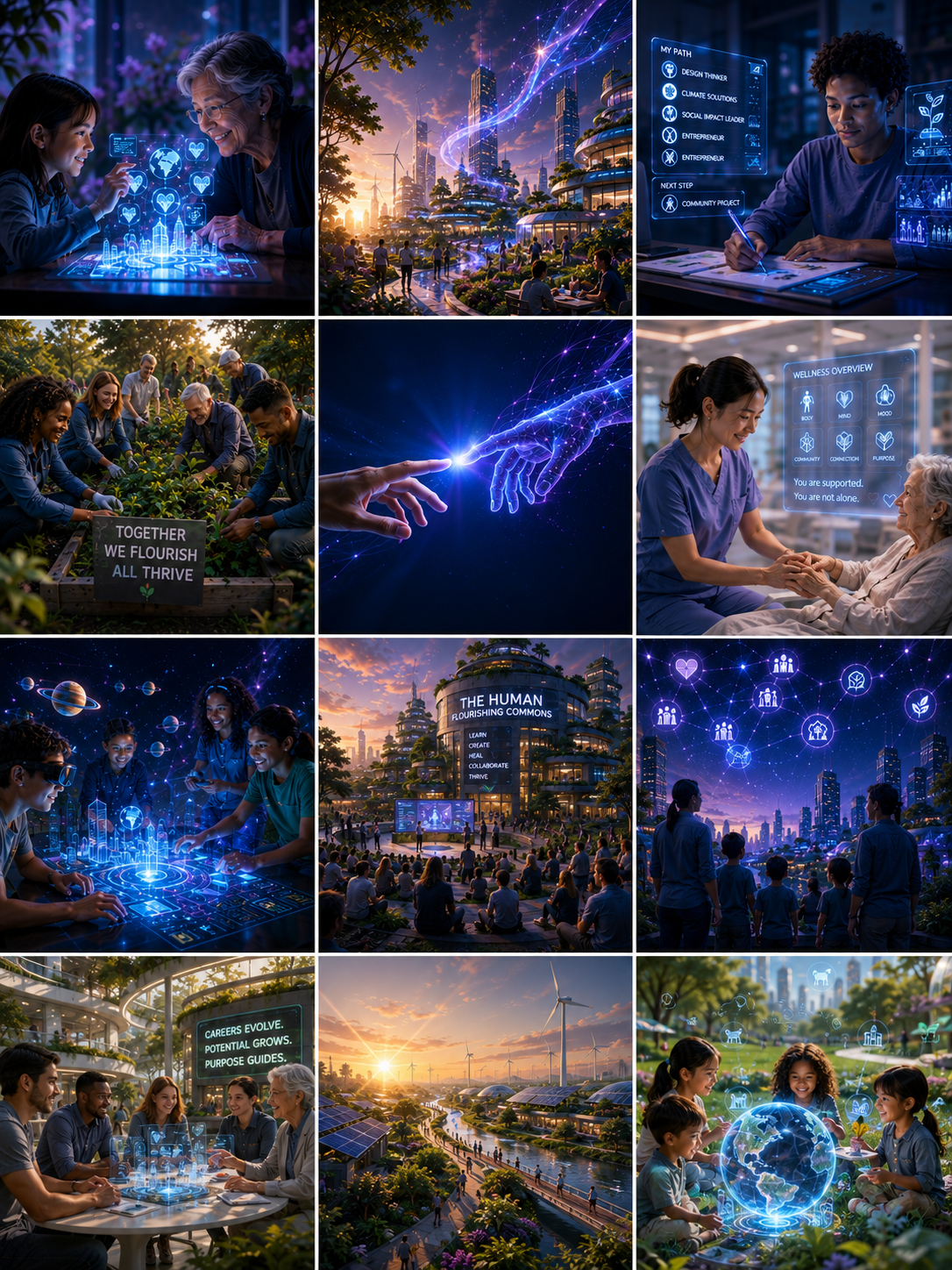
A gentle pulse on her wrist display. Not an alarm — an invitation. Her mentor has noticed three consecutive nights of disrupted sleep. It suggests a 7-minute guided breathwork session instead of the morning news. She accepts. By the time she's made coffee, the cortisol graph she'll never see has already shifted into a healthier range.
Six weeks ago, during a conversation about her love of scuba diving, her mentor flagged a connection to a research frontier she'd never considered. Today she's in a holographic immersion session with a scientist in New Zealand and a student in Lagos. The Learning Commons adjusts the session complexity in real time. She's working at the edge of her knowledge — the most alive place to be.
Her mentor surfaces an opportunity: a 6-month fellowship with the Pacific Coastal Restoration Collective. It matches her skills at 94%, her values at 97%, and her current development arc perfectly. It wasn't in any job board. The network found it because it understands her — not her resume, but her.
Twelve people, ages 17 to 71. A retired ecologist, two teenagers, a former logistics manager, a grandparent who planted trees for 30 years. The network connected them not by proximity but by complementary purpose. Maya coordinates the afternoon's work on a shared holographic map. The river is coming back. So are they.
Her mentor doesn't give grades. It asks. What surprised you today? What felt alive? What do you want more of? Maya types three sentences. The mentor listens, adjusts tomorrow's suggestions, and saves nothing it doesn't need. She sleeps. The network remembers everything that matters.
Chapter Four
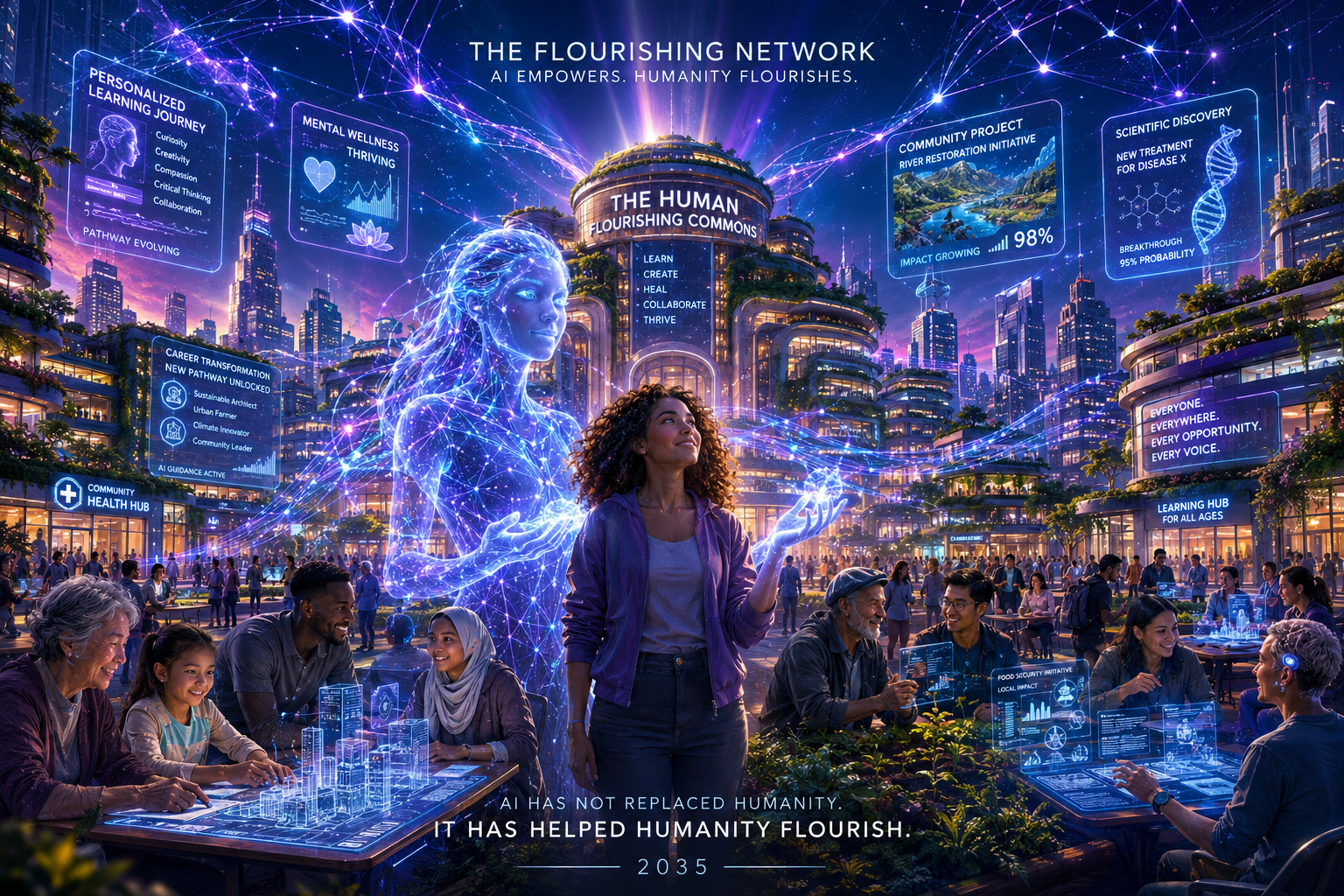
Not a government building. Not a school. Not a hospital. Something entirely new — a civic institution that never closes, belongs to everyone, and exists for one purpose: to help you become who you are meant to be.
Adaptive learning environments that meet every mind where it is — curious, blocked, accelerating, or resting. Tutors, immersion labs, and creative studios, open to all, free to use, always adapting.
Whole-person care — body, mind, and community. Preventive wellness, mental health support, and healing programs integrated into daily life, not rationed behind insurance walls.
Citizen science, collaborative discovery, and open knowledge commons. Anyone with curiosity and a contribution can participate. The next breakthrough might come from a 15-year-old or a 72-year-old.
Ideas become projects, projects become ventures, ventures become impact. The Commons provides mentorship, prototyping, funding pathways, and a community of builders who share your values.
The gathering space at the center of everything. Where strangers become neighbors, where generations meet, where stories are shared, and where the network becomes visible as something warm and human.
Chapter Five
In 2031, 47 nations signed the Helsinki Accord, retiring GDP as their primary societal metric. Society now measures what it always should have measured: the quality of human life, in all its dimensions.
Chapter Six
Flourishing is not a single achievement. It is an emergent property of interconnected systems — each one strengthening every other. Remove one, and the whole diminishes. Strengthen one, and the whole rises.
The Flourishing Network isn't a product or a platform. It is the connective tissue between these systems — ensuring that what happens in health strengthens education, that community resilience informs governance, and that technology always serves humanity and never the reverse.
Chapter Seven
Systems don't flourish. People do. Here are seven lives the network helped shape — each one an ordinary miracle.
I thought retirement was the end of contribution. Instead, the network matched me with 340 students across four continents. I teach eight hours a week. I feel more alive than I did at 40.
When the facility automated in 2029, I had six months of support, a reskilling fellowship, and a mentor who had made the same transition three years before. I didn't fall. I pivoted. Now I'm building what replaces what I left behind.
My school didn't have a marine biology program. The network connected me with a researcher in Tokyo, a lab in Bergen, and four other students who cared about the same reef I could see from my window. We published our first paper last month.
I spent three years feeling like my art wasn't real work. The network helped me see it differently — and then connected me with a city council redesigning public spaces. Now I'm paid to do the thing I was ashamed of loving.
The Commons gave me childcare, a business mentor, a micro-grant, and my first customer — all in the same building on the same day. What I needed wasn't a handout. It was a fair start.
After Ingrid passed, I didn't know how to be in the world. My mentor didn't offer solutions. It offered presence — and then, gradually, it offered connection. I'm not over my loss. But I'm in it with people who understand.
Chapter Eight
The Flourishing Network didn't succeed because of extraordinary technology. It succeeded because society asked a different question: not "what can AI do?" but "what does every human being deserve?"
The network advises. It never decides. Every suggestion is transparent, every recommendation can be declined, and every person retains full sovereignty over their own path. Technology serves the human. Always.
Flourishing is not a premium feature. The network is a public good — funded, governed, and available to every person on Earth, regardless of their income, location, language, or starting point.
Individual growth is not enough. The network measures its success not by what any one person achieves, but by how the wellbeing of the whole rises. When one flourishes and another doesn't, the network asks why.
The network is governed by a Global Flourishing Council — elected, independent, and empowered to audit, correct, and override any AI decision that conflicts with human dignity. Oversight is not optional.
Decisions within the network are evaluated across generational timescales. Not quarterly earnings. Not election cycles. A 50-year horizon for every major choice — because the children of 2050 deserve the decisions we make today.
We once asked: "What can AI do?" The better question became: "Who can humanity become?"
THE FUTURE ISN'T SOMETHING WE PREDICT.
IT'S SOMETHING WE BUILD.